On school days, I’m the short-order cook:
-
Toast with butter and Nutella (Oliver)
-
Brioche toast with butter (Annabel)
-
Pancake with whipped cream and Cheerios (Theodore)
-
Rice Krispies (Madeline)
Somewhere in between all that and my own breakfast and assembling lunches and filling up water bottles, I’d run Oliver and Annabel through their numbers: multiplication tables for him, addition and subtraction for her.
It worked surprisingly well. But this year I wanted two things:
-
Cover more subjects
-
Reinforce what they’re learning at school
Then, sitting at Back to School Night in September, it hit me that I could pull the School District of Philadelphia’s curriculum and get a broad outline of what the kids would be learning through the year. Between that and the barrage of Remind notifications school parents get these days, I could build an app that covered both kids’ curriculum and surfaced five or six questions every morning for me to run through with them over breakfast.
I tipped away at that for a few days, first thinking through the product spec and shaping the prompt. Once I had everything, I put it into Claude Code. After two or three sessions, I had the first version of my app.
How it works
It runs the district’s actual curriculum, unit by unit, for a third grader and a kindergartner, and I told it where each kid was from what they’d said about class. Each morning it picks one subject: math, reading, Spanish, or “world” (science and social studies). A question I’ve already asked comes back in 1, 3, 7, 14 or 30 days depending on their right answers, and three right in a row moves the student “up” a level. Every morning at 6:30, as I drink my second cup of coffee, it reads the teachers’ Remind posts and emails, so the questions follow whatever happened in class that week.
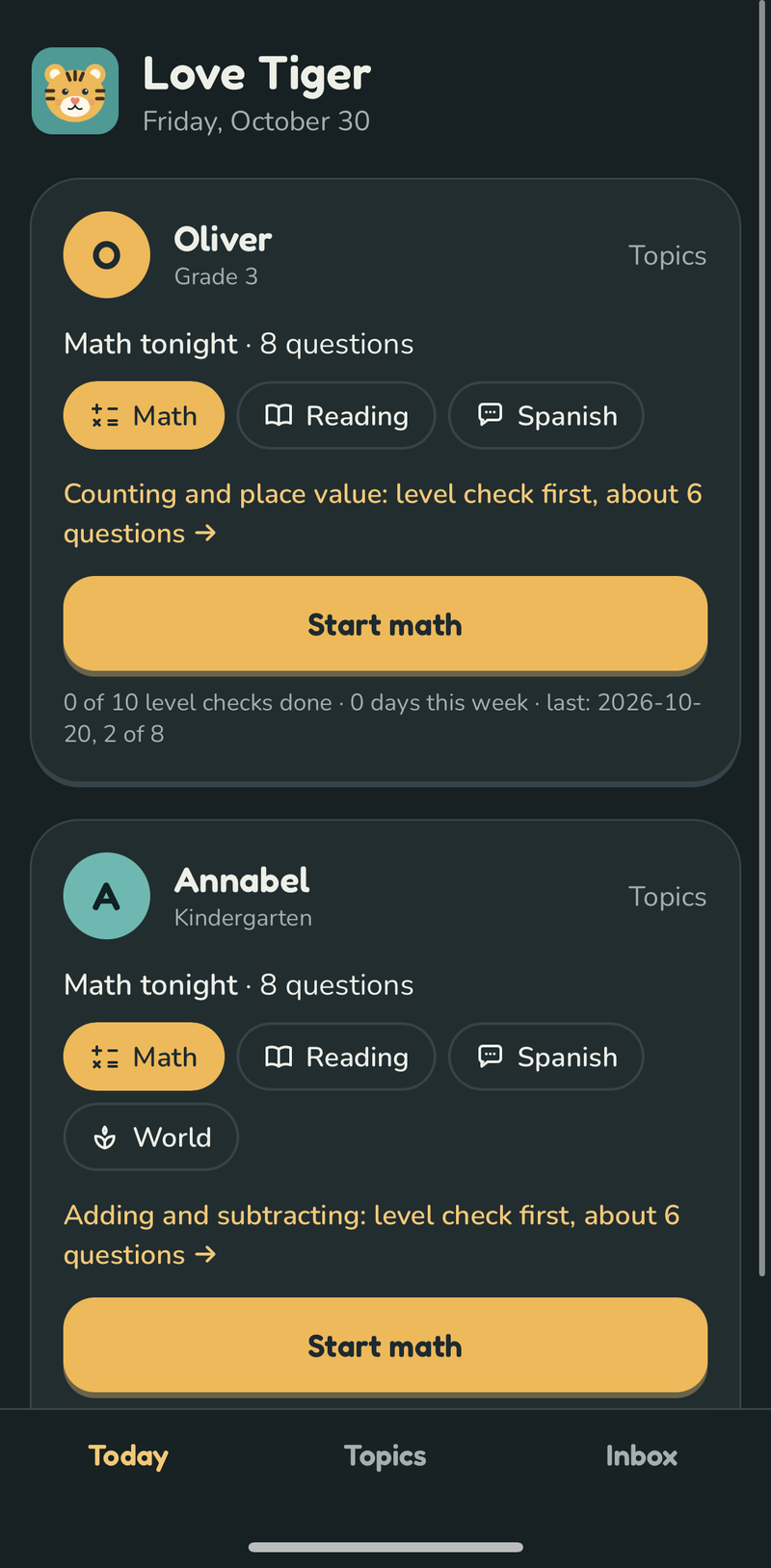
There’s no AI in the session itself. The questions are written and approved ahead of time, so the app is a deck of flashcards on my phone, not a chatbot. A few from the last couple of weeks:
-
“Why was Fern so upset at the start of Charlotte’s Web? What did she do about it?”
-
“Picture a muffin tray with 9 rows of 7. How many muffins in all? What’s the multiplication? Now turn the tray sideways: what’s the multiplication now?”
-
“8 bags with 2 cards in each. How many cards in all?”
-
“How is garlic like a radish? How is it different?”
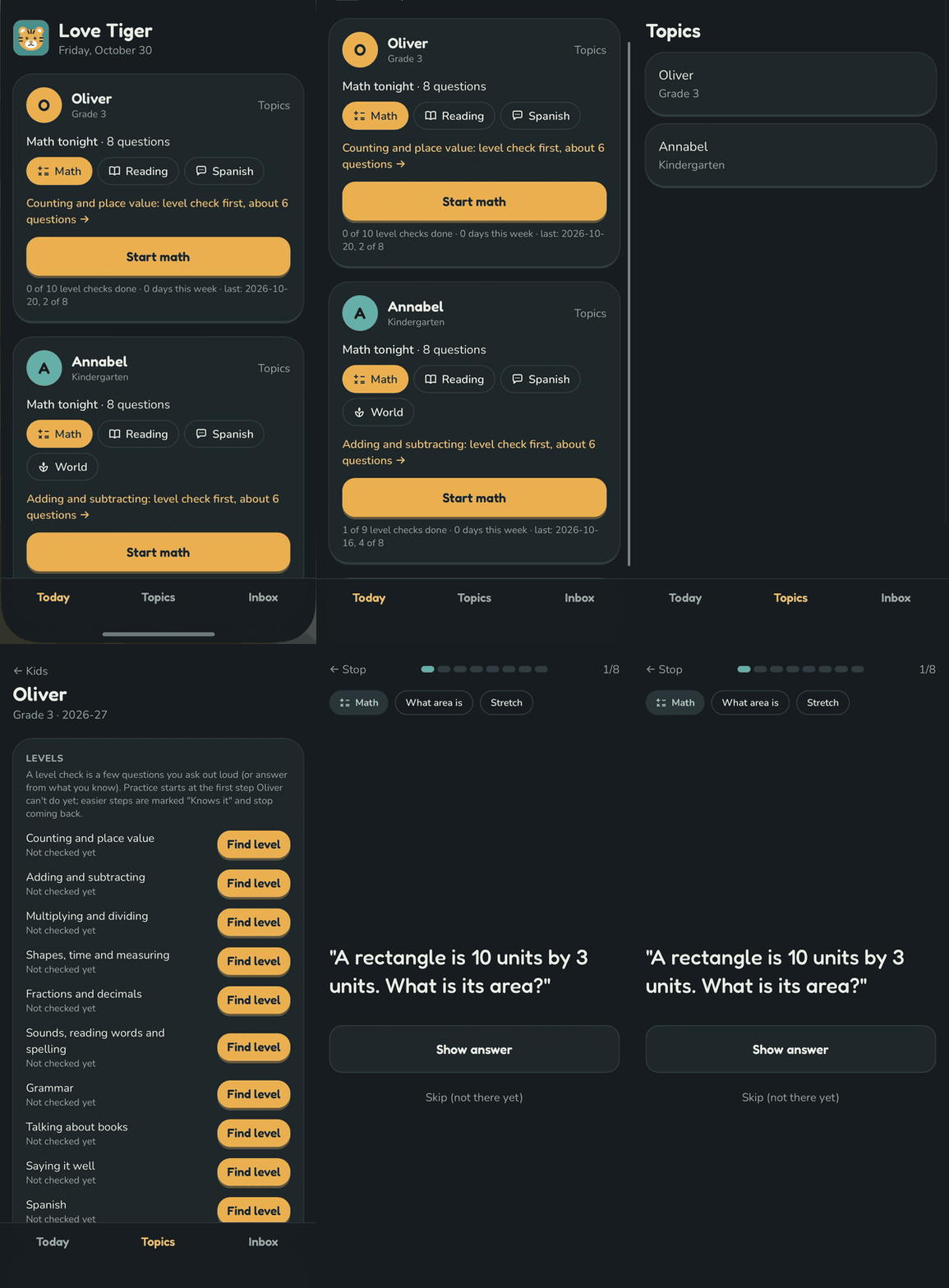
The first week it was far too easy for Annabel (she reads Dog Man to Theodore and just finished I Survived the American Revolution, 1776), so that needed a serious recalibration. After that, it just… worked. A session takes about five minutes. We don’t get to it every school day; the app keeps track.

Love, Tiger
I call the app Love Tiger. The name comes from being a tiger parent.
If you missed the discourse around being a “tiger parent,” the tl;dr: in January 2011, the Wall Street Journal ran an excerpt from Amy Chua’s memoir, Battle Hymn of the Tiger Mother, under the headline “Why Chinese Mothers Are Superior.” Chua, a Yale law professor, listed all the things her daughters were never allowed to do, e.g. sleepovers, TV, a grade below an A, any instrument other than piano or violin.
The internet lost its mind, and we’ve had a name for how Asian parents (stereo?)typically treat their kids ever since. A tiger parent pushes their kid toward excellence in all things academic (and beyond) and doesn’t much care whether the kid is having fun.
And there are parts of this approach I agree with! Underneath tiger parenting is an idea about where a person’s value comes from: how smart you are, how hard you work, what you can contribute. I think there’s something to that. It’s more important to add value or to be useful than to be entertaining or fun to be around. (Yes, those matter too. I’d like my kids to get invited places.) So that’s why we push them.
But there’s a lot I don’t agree with. I think for a lot of the generation before us (and I don’t mean my parents here), the pushing wasn’t actually about the kids. It was about the family unit, or, in a more selfish reading, about the parents themselves. The kids were merely an extension of the parents, and that’s why they pushed. It didn’t necessarily come from a place of love. It came from a place of ego and validation, and a kid going to an Ivy League school was just part of the scoreboard.
The “love” is there because I want it to come from the right place. I’m not trying to produce the number one student in the third grade in Philadelphia. I’m trying to get two things to stick:
-
You have to learn how to push yourself, and how to be pushed.
-
The harder you work, the more useful you can be in your life and the life of others.
Starbucks
A few Sundays ago, Oliver and I were coming home from his tennis lesson. He asked to go to Starbucks. My knee-jerk reaction was “no.” He started to whine. We got into a small fight about it.
Why did I say no? Well, I don’t want him to think we get treats for no reason. It’s the way I was brought up: you earn special occasions. We don’t get things just because.
Which feels arbitrary, especially as I write this out now.
Is that the right approach? Am I too strict?
I think two things.
One, my parents did it this way. Partly because their parents did it that way, but also, we needed the money. We saved. We cut coupons. We only got McDonald’s if we had a BOGO free sandwich from the Entertainment Book.
Two, I’m afraid I’m going to raise spoiled children who don’t know the value of money, the value of hard work, and all the old-man-shaking-fist-at-cloud cliches that go with that. It’s old school and perhaps misguided, but there are monsters and villains out in the world, literal and figurative, and you need some of that tiger in you to survive and thrive.
Then other times… you just need love.
Finding the line between the two is hard.
The kids are alright
In September, my mom visited. We were walking back from dropping the kids off at school. She told me she wished she’d done more for us. She wished she’d paid more attention, checked our homework, been more involved, that kind of thing.
I told her:
“We all know you did your absolute best, and we think you did a great job. So don’t spend any time thinking about it. Everyone turned out alright.”
It’s true. Everyone is “settled.” More importantly, my siblings and I all talk to each other, we look out for each other, and we enjoy being in each other’s company.
My mom looks back thirty years and wonders if she did enough. I look back on one Sunday and wonder if I was too hard. Neither of us knows. You probably never do.
What I’m trying: picture yourself looking back and ask, what would you change? Then make the decision, that day, to course correct a little. Ideally, you can find a rule so you don’t have to make the call from scratch every time. Mine, for now: on weekdays, I make more room for tiger parenting, and on weekends, I make more room for love, tiger.
Thirty years from now I’ll find out which way I leaned. But if my four kids still talk to each other, look out for each other, and enjoy each other’s company, I’ll know I did my best. And that the kids are alright.
⭐ Recommendations
🔌 What else I’ve been building
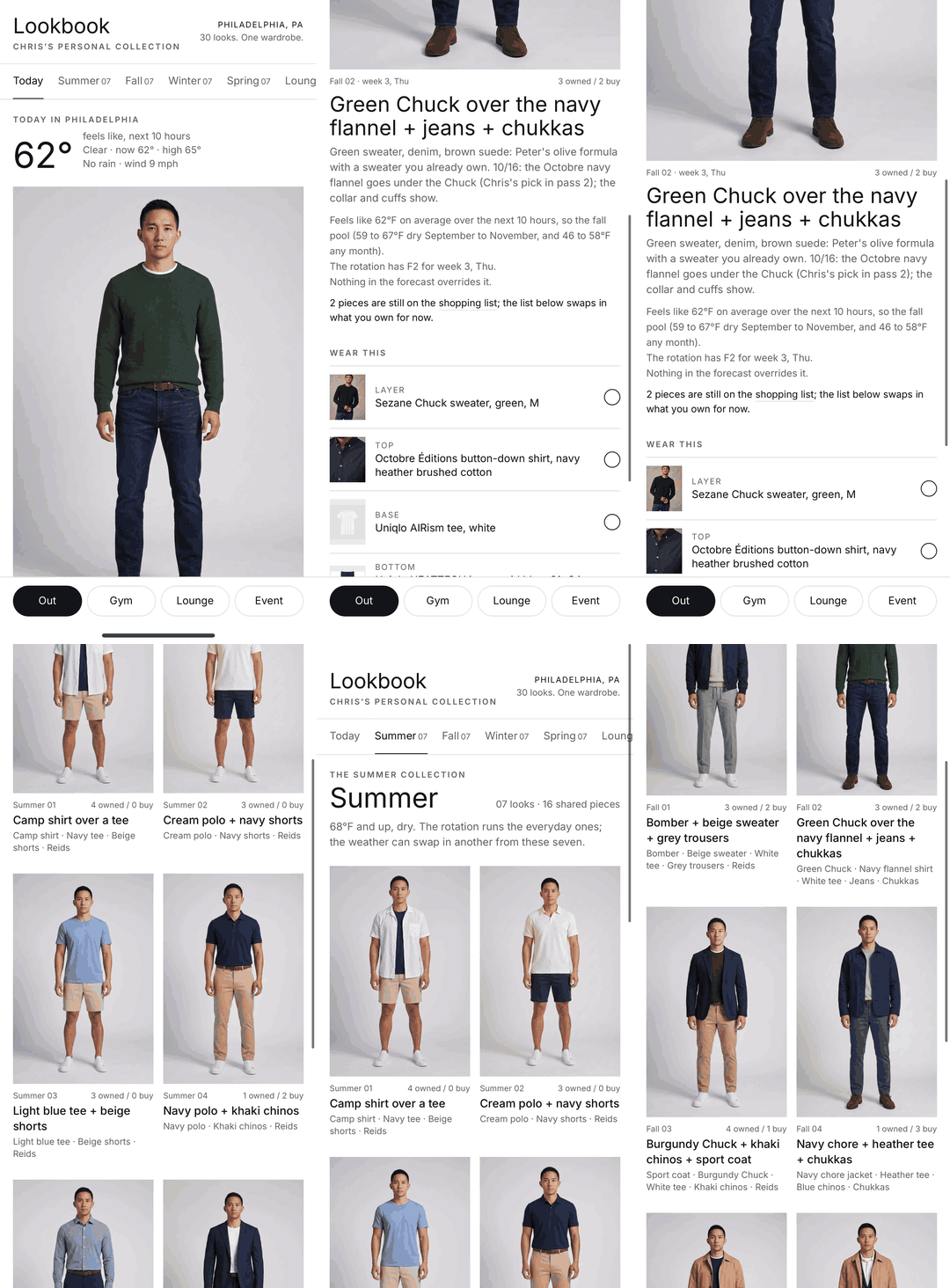
👔 Lookbook. Here’s another app that I built. I cribbed the idea from Rowan Cheung, CEO of The Rundown, who had AI build him a wardrobe app: 30 looks (seven per season, plus gym and lounge), with a daily pick based on the weather. I built mine from Peter Nguyen’s Slow Style course and what’s actually hanging in my closet, and added a short list of what to buy next (and what not to). Every look has an AI try-on of me wearing it. All thirty cost about $10.
📺 Watching
🎃 Home videos. I started making home videos again. Here’s a highlight of our Halloween.
😱 Buddy. Stayed up way too late on a school night for this one. Deranged, fun, and exactly the right level of camp.
🩸 Leviticus. This is an Australian horror movie: two teenage boys in a small, conservative town fall for each other, and a demonic entity starts coming for them. The director has said he wanted to make a horror movie where the fear was homophobia. I liked it but didn’t love it. It’s worth it if you’re a horror fan in general.
🧗 Fall 2: Deadpoint. I recommended Fall back in September, so it’s only fair to report on the sequel. Same verdict as Leviticus: I liked it but didn’t love it. If you liked the first one, it’s worth it, just not as tight. The surprises and twists are a bit more contrived this time, and less connected to the main character’s trauma.
📖 Reading
📕 The Everlasting by Alix E. Harrow. Really enjoyed it. The language gets a bit flowery in spots, but the concept underneath is so good it carries the whole book, with just the right amount of twists and turns.
📬 What else I’m writing
If you want to see the other newsletters I write every week:
-
Good Morning Philly, a free Monday morning briefing on Fishtown, Northern Liberties, Kensington and Port Richmond. Latest issue.
-
Remote Life OS, on remote work and portfolio careers. Latest essay: 🍲 How I use AI to supercharge my portfolio career.

Comments are closed.