Author

Chris Ming

Browsing

There were dozens of fingerprints on it, but it was my world. I was the Alpha and the Omega, bitch.

Unfortunately, the execution was flawed. I populated my world with creatures to roam the land… but forgot to give ‘em lungs to breathe the air. Oops.

So when my friend Richard brought up a project called SUBTEXT by the Pander Brothers over lunch, it felt like a gut shot at first. He read the logline: “A young woman is led into a tryst by her boyfriend via phone texts, only to discover a painful truth about their relationship.”

That sounds a lot like your TEXT web series, doesn’t it?”

It did

But the idea is malleable, like pressing Silly Putty onto a fresh newspaper: even though the words were the same, there is an infinite number of shapes and configurations. No, the idea wasn’t stolen or borrowed or lifted. It was just a good idea.

My friends and I tried to shoot TEXT two years ago. At the time, I had a good script, but lacked the vision to pull the project together in the only place that counted. Which wasn’t the page. The script was just a blueprint. When a skyscraper wobbles or your tablet crashes, you don’t see anyone crying over the CAD drawings, do you? I didn’t get it right in the fabric of space and time, where I was accountable for light and sound and shots and the intangible goodwill of friends who sacrificed a weekend to make my vision a reality.

But Man, The Idea Was Good

That I know for sure. It’s reassuring. If I have 10 more ideas, if I’m lucky, I’ll have 1 good one. So I have to get through the 9 not-so-good ideas first. Of those 9, perhaps 2 will be worth executing, for the purpose of learning to execute.

Which runs counter to an idea I heard recently, about passion projects. I heard this nugget from a blogger the other day (excuse the lack of attribution, I have no idea where it came from): “If it’s not a joy to make, don’t make it.”

She suggests only taking on projects that are a joy, because that joy will drive you past the Dip. It will drive you to the finish line. But I think this idea deemphasizes the importance of practice. Of learning the chops — which isn’t always a joy.

If you’re a professional, it doesn’t matter if a particular project is a joy, or if it’s your passion project. You bring your fucking A-game no matter what. You prepare, you sketch, you debate, you run over every possible outcome from A to Z. Yes, there are moments of joy. In equal parts as moments of “what the hell did I get myself into?”

Learning Chops

Lake Bell wrote and directed her short, WORST ENEMY first, as a means to learn the chops before she directed (and produced, and starred in) IN A WORLD…

My father opened his first Japanese restaurant in a wonderful but small town. There were only 37 seats. Which gave him the chops to open a bigger sister-store in a more trafficked location, with about 80 seats. He lost a lot of sleep over the restaurants, and took on a great deal of risk. There were a lot of those “what-the-hell” moments. And neither were his passion project — but they paved the way to  the third restaurant, which is.

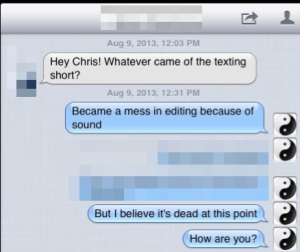
Someone who helped me with TEXT recently, um, texted me, and asked “Whatever came of the Texting short?”

I considered fibbing: saying it was stuck in post, or there was still hope to fiddle with it. No one else had said otherwise yet, so technically it was true.

Instead, I admitted the truth: the project was dead.

text

Saying it aloud made it true. It made the failure real. More importantly, it embarrassed me, but it didn’t kill me. It did not make the good idea a bad one. It made it clear the only thing left to do was find more good ideas, and make them real. Alpha and Omega.

Photos Credit: Ruben Ras

Hopping aboard any digital sharing bandwagon was always a struggle: Twitter, Foursquare, Facebook. Before that: LinkedIn, LiveJournal, MySpace, Xanga.

So on. So forth.

I didn’t gravitate towards voicing my opinion on pop culture and politics

Or what I had for breakfast. Didn’t think this literature was worth the digital space of 1’s and 0’s it took up. I made attempts through the years, but never felt strong doing it.

It’s easier, I think, to catch this early wave of social sharing that leads to YouTube sensations and pop-culture-websites-to-book deals when your parents convinced you you’re a unique snowflake whose opinion carries weight, even if it’s the opinion of a 12-year-old girl who’s never wanted for anything except a pair of Louboutins. Or your parents taught you education isn’t an institution but a street market in New Delhi where grades can be haggled over, and that your spot on the “A” soccer team isn’t hinged on being one of the best 11, but because of the $3,000 donation towards the booster club’s new bleachers.

My first day of work, ever, I wore pleated Dockers, a checked shirt and plastic Payless shoes, the latter of “Buy 1, get the 2nd ½ Off” sale. My father sat at the kitchen table, putting on his socks, which is where he attended to all things foot-related. He offered one nugget of advice, one sock already wrestled up his calf, and the other in his hand: “Don’t talk back. Listen first. You don’t know as much as you think.” The idea stuck with me.

Not always in a good way

It’s held me back times when I should have stepped forward. When I was the smartest person in the room (admittedly, a tiny room). Instead, we’d follow the leadership of someone who didn’t think from A to F, never mind A to Z. Who struggled to spell “piss” and do it when confronted with a toilet. But she was bold and fast and not scared to look foolish. She stepped forward and there’s merit in that.

Anyone with an Internet connection can step forward now. We’ve all got a soapbox. We just need to make the choice: shout at every passerby, refusing to be drowned out by everyone else clamoring for attention? Or do we whisper, so that the few who want to listen, must lean in? If the latter, we better make our message worth the lean.

Answering that challenge is difficult. To quote the hipster I overheard at the Last Bookstore on Spring and 7th in downtown Los Angeles: “it’s all so completely derivative, man.” He might be right.

A Byproduct of Self-Dev

I’ve never shied from the fact that I’m a byproduct of self-dev. I’m the amalgamation of those self-help aisles in Barnes & Noble with placards that boldly proclaiming LEADERSHIP and MANAGEMENT and RELATIONSHIP, always questioning whether this iteration of me, with the cheap haircut and hand-me down clothes, is in fact the best version of me. I’m also the byproduct of all those times I listened when maybe I should have spoke, not because I didn’t understand the words but because I wanted to stay inside myself, and take it in.

It’s left me behind those who can form an idea and Tweet it out to the Universe with naught a thought. I’m still calculating. I pause — “Is this what I’m really thinking? Is this how I actually feel?” I’m not far behind though. Everyday for these last few years, I’ve grown a little more confident. Still listening, still taking in all in, but with a little more hand raising. A little more, “I’ve seen this. I’ve done this. I can lead the way.

Photo Credit: Shuo Wang

I wrote about the Use of Feedback to calibrate my work. Today I wanted to write about Barriers. I define a barrier as a tool or technique that prevents distraction.

I remember in college, I had friends who complained about being unable to study. They said they couldn’t focus. They became web doctors and self-diagnosed themselves with ADD or dyslexia, not taking into account their study environment. Nothing about their environments were conducive to studying: it was a dorm room where either someone was playing a videogame, or the television was tuned into the latest rerun of NEXT TOP MODEL.

The answer seemed ridiculously simple: turn that shit off! Right? Wasn’t it easy?

The Nonstop News Feed Of Our Lives

The more I thought about it, though, the more I realized it wasn’t so simple. What I realized is these were all intelligent people, and if the solution were a simple “off” switch, they’d have done it already. But our default environment today is one of non-stop stimuli and instant gratification:

  • Email – we know the message is transmitted and hits their inbox instantaneously.  So we expect a prompt response in return.
  • Information – any morsel of information is available on the Internets, and access is nearly ubiquitous, across any number of platforms (computer, phone, tablet) so if we want to know something (e.g., how far is the earth from the sun?; what was Coriolanus’s mother’s name?) we expect to find out right away. Information retrieval is an exercise in instant gratification.
  • Text – as long as they have their cell phone on them (which most of us do) we know they’ve received the message right away. So if we asked them a question, we expect a prompt response.

newsfeed

We’re conditioned to life’s nonstop news feed, which has restricted our ability to shut down. I believe this ability is a muscle, and like any muscle, it needs to be developed. It is a skill we must acquire. The  idea that’s it’s worthwhile to develop this muscle, has been made so clear as I study people I admire and see what they’ve accomplished in short amounts of time. A shortlist: Ted Melfi, Charlie Hoehn, Jeff Bezos.

There’s so much to accomplish, but getting through the task at hand requires a high level distraction-free focus. You’d think this requires great will power, but it doesn’t. It requires taking will power out of the equation. Thus, the objective changes: don’t fight distractions, but pre-empt them. Will power has no say in the conversation. Which is done through Barriers.

My Barriers

Here’s a list of barriers I use to make distraction a non-issue. I didn’t implement these all at one time. (That’s akin to telling my friend (above) that in order to study better, they need to change all their habits. Or “just focus harder.” It doesn’t work.) These barriers developed over years, one at a time. They keep me focused despite the new feed of our lives:

  • Don’t push e-mail – I’m probably a rarity for Hollywood assistants who don’t push e-mail (e.g., get a notification when I receive new e-mail. Many claim this isn’t an option for them. I sympathize. It must be utterly demoralizing to receive pings on your phone at any point in the day. I have the good fortune of working for agents who understand there are two choices: you can either respond to every ping, or you can get to work. They prefer the latter, as do I.
  • No TV – When I visit my family, the TV is always on. I’ll walk by and see ENTOURAGE or THE SHAWSHANK REDEMPTION is on, and I’ve basically forfeited an hour of my life. Because I don’t have the willpower not to watch.
  • Freedom and LeechBlock – Browser tools that prevent you from using the Internet.
  • I carve out time to be alone – Mostly in the morning. When it’s still dark out, after I’ve eaten something and hours before I let myself check e-mail.
  • No music – Which is a complete 180 degrees turn for me. I once required blaring music to tune everything out. Until I noticed it was tuning out my own thoughts.
  • TK’s – I write every time I come across something I need to research or look up. Rather than lose my flow, I write TK (which stands for “to come”). I’ll return and fill in later.
  • Phone is off

I compare the time when I can put all my barriers to use, versus the time I spend in the office, and all my lines are ringing and I have to jump from executive to executive to executive and schedule all their meetings. So much more gets done without the distractions.

What barriers do you use?

Photo Credit: Huw Gibbs

“I’m prioritizing so hard it hurts.”

I first heard BJ Fogg, a Stanford professor who studies and teacher persuasion, utter this expression a year ago. As I listened to his interview (again and again — check it out here) I tried wrapping my mind around that idea. I didn’t get it, until a recent Saturday afternoon (which I’ll get to it below). The circumstances in which prioritization can inflict pain and cause ache suddenly emerged into focus.

The Progression of My Understanding

First the easy part: awareness  at the macro level, all the things you want to accomplish with your life. This is the long list of projects gathered and standing idly on your life’s to-do list, looking sophisticatedly bored, with “Hello, My Name is” tags like Learn French, Become a Working Actor, and Run a Marathon.

My list at the moment looks like: Build a Personal Finance Blog for Young Hollywood Professionals, Work for a Best Selling Author, Shoot Another Web Series.

The Granular Level

Next is the micro view, breaking these projects into actions, and understanding the next step at the granular level. The macro is understanding our year (or 3 years or 5). The micro is how we’ll spend the week or day. When I say granular, I mean, knowing precisely what you’re going to do for the next hour, in five-minute increments. That’s the exactness required.

Yes, it’s exhausting. Accomplishing life goals should be.

For me, that means when I wake up, if the plan is “Work On The Blog,” then I know which post and where I left off (annotated with “MING YOU ARE HERE”). If I’m studying a development course, in my notes I’ve marked where I’ve left off (e.g., Module 3, Video 2, 12:38). When I get to work, if I’m in the middle of an Option Agreement, it’s opened on my computer, a document next to it where I’m making my comments.

This is what granular looks like (gaps typically mean I’m at work, where I keep a different calendar). The idea of using Google Calendar to borrowed from Scott Dinsmore:

Time

The third component of prioritization is understanding how much time everything takes. At the granular level. Not, “just start now” or “if I work at this for ten years, I’ll be successful.” Not that it’s not true, but it’s difficult to take any action at such a high level. What this looks like: “okay, this blog post will take me 1 hour to write. After that, it’s going to take me another 30 minutes to post because the formatting screws up after adding headlines and images. So really, I should  budget an extra 45 minutes. That’s how long the last few took.”

I accommodate this time into my schedule. Then I come to the all too human conclusion that there aren’t enough hours in the day. However, I understand why I’m doing something , what I’m doing, and how long it’ll take, so there’s this huge fundamental shift in how I look at time. The cliché, “not enough hours in the day” transforms to “I need to find a one-hour block to fit in this research but the only time I can give up is time allotted for drinks with John. Which is more important?” The first time I made that transition, I finally understood B.J. Fogg’s words, “you have to prioritize so hard it hurts.”

Cal Newport explained it a different and fantastic way: when you master the skill of manipulating your time, it’s like seeing the Matrix.” You see how all the pieces fit together. If you need to free up a chunk of time you can move this piece here and make room for it.” Seeing the Matrix is a skill you develop, through judicious practice, and an understanding of exactly how you work.

Personally, solid chunks of uninterrupted alone time (1 to 4 hours) are precious. Ask any assistant how often they have enough uninterrupted alone time to write an email, never mind string together 500 coherent words — it’s like unicorn hunting. Which is why to me, my mornings are sacred. Especially Saturday mornings, which I try reserving just for writing.

Prioritizing So Hard It Hurts

But one particular Saturday a few weeks ago, I scheduled a lunch, not giving much thought to it at the time. I tried squeezing in work before it, but it takes me 30 minutes to an hour to even get into the right headspace, and by the time all the engines were firing, it was time to make a 45-minute drive over the hill. (Neil Strauss says that’s why he keeps all appointments tentative: if you get going, don’t stop — you don’t know when it’ll come back.) The lunch was amazing and productive and will hopefully lead to an amazing partnership, but I was still berating myself for not defending my creative time more judiciously.

Amy didn’t quite understand why I was so upset with myself. “It’s only one afternoon,” she said. She was right: it was only one Saturday afternoon, with many more to come. I couldn’t really explain the feeling, until now: I was upset because the circumstances were completely within my control — this was a lunch I scheduled. I could have chosen another date, but I didn’t, so I let that determine my day.

I prioritized poorly. It hurt.

Photos Credit: JSN Skeet

I wanted to write about Feedback, Barriers, Stakes, and Batching (though I covered some thoughts on batching in My Morning Routine). I put off exploring these ideas and concepts because:

  • Covering all of them felt extremely daunting
  • Tactically I hadn’t worked out a system to implement them
  • Wasn’t sure if my ideas were completely fleshed out

However, the only way I’ll eventually get through all three is by first exploring one. Thus…

What is Feedback?

Feedback is the process of soliciting criticism for our work, using focused time to filter and distill those criticisms, and meaningfully implementing changes to improve in the long run. “Constant calibration” is another way of putting it, but CC doesn’t quite capture the essence of feedback I think is most important to recognize: it’s really fucking uncomfortable.

The discomfort happens across a spectrum of projects and endeavors, but it always feels the same. Whether I’ve started a new project and need to email friends for their feedback, I want to raise my hand to ask a question at a panel, or I need to defend my position on a deal point, my body always runs me through the same gamut: my stomach drops, I become very aware of my tongue, the hairs on my arm bristle, and a heat spreads across my neck like a warm breath.

These feelings used to be my cue to eject. Excuse myself, stop what I was doing, get the fuck outta dodge.

Now I’m reading the feelings as, “okay, this is where I want to be.” If it’s uncomfortable, it’s personal. If it’s personal, then you give enough of a shit to make it better. That’s the only purpose of receiving feedback. It’s saying, “this one matters, so make sure you get it right.”

Years ago, when I only thought of these ideas in the abstract, I told my friend Joshua, “not asking for help is something that’s held me back for a long time.” I didn’t know how to be in that discomfort zone. Growing up, no emphasis was placed on short-term failure in exchange for long-term gains. Mistakes were examined through a singular lens: “don’t make them.” (To be clear, I don’t blame my parents or upbringing for my hang-ups. They were (are) loving and amazing. As J.K. Rowling said, “There is an expiry date on blaming your parents for steering you in the wrong direction; the moment you are old enough to take the wheel, responsibility lies with you.”
Source

The more I encounter better thinkers, the more I realize the importance of high-feedback environments and tight feedback schedules. This means: getting quality feedback, on an expedited, regular timetable.

Examples of high feedback environments

How Good Writers Become Great

Great writers work with great editors (the editor doesn’t have to be an Editor. It could be a manager, an executive, a friend.) Someone who’ll push your abilities past their current level, who won’t let you publish until every word has earned its place on the page. While blogging and self-publishing has its place in the world, I wonder if it’s stopped some very good writers from becoming great writers. In the mad dash to put something out into the universe, we may not hone our abilities or polish the product before offering it to the world. (With so much stimuli clamoring for my attention, I know I don’t.) “Great” is sacrificed for the result of “done.” I think we need to seek a balance, between shipping to get to done, and shipping because it’s only through shipping we’ll leap to the next level.

Literary Option Agreements

Preparing and making comments to a Literary Option Agreement is a high feedback environment of mine. It’s made up of several components:

  • Consistent exposure — between three bosses, there’s always a deal pending.
  • Regular assessment — my comments are reviewed immediately (i.e., within a day). I see right away how certain language should be phrased.
  • Regular discomfort — receiving comments back from the other party is always uncomfortable. I go through rejections (of comments) but more importantly, I see the logic their rejection was based upon.
  • Deliberate calibration — armed with their logic, I can compare to previous deals to deliberately find ways to close the deal point.
  • Real-time calibration – on the other hand, when I listen to calls, I learn the nuances of a live negotiations. I see this is the standard and speed I need to be able to implement the previous step (deliberate calibration). I’m exposed to mastery: the ability to put together a good deals in real-time.

Attraction and Social Dynamics

On a less literary note: for as long as I’ve known him, my friend was good at meeting new women. Then one fall, he started working in a nightclub with major traffic, and that experience launched him to a new level. Because in this environment, he was exposed to countless opportunities for feedback. He literally had the opportunity to hit on 100 women in one evening. There was never a formal process: he didn’t study his tactics, or “go over yesterday’s tape,” so to speak. He just landed in an environment of extremely high feedback level, where he could barely get rejected before he was presented with an opportunity to try again. He put his environment to use.

Creating a high feedback environment

In their career mastery course, Scott H Young and Cal Newport covered using quantitative metrics to supercharge your feedback and to create tangible skills. Tactically speaking, I won’t get into career factors or career metrics (thought I acknowledge their importance.)

For my purposes, if I’m struggling to create a habit, I have to systematize the process so it happens automatically. In creating a high feedback environment with a tight schedule, I need a system that automatically pushes me into my discomfort zone. I still don’t have a formal outline of what this looks like, but some attributes would be:

  • Smaller group projects — small because lowered stakes will force me to get to done. Group because it forces accountability. Also, in a group project, “any failure is a public failure, but no failure will never be fatal” (I believe this quote is most commonly attributed to Seth Godin).
  • The right people — these are more difficult to find than you think. The “right” people can be critical without discouraging. They genuinely want to see you do better, and understand at the big picture level what you’re trying to create and believe you’re capable of it.
  • Deadlines — a tight feedback schedule requires deadlines with real stakes. The amount of time a project requires will expand or shrink in proportion to when it’s due. So without a deadline, the project can drag until gravity and friction stop the momentum forever.

In my queue of projects there’s one specifically that I’m both slowly getting feedback on and using as a sort of beta to create a formal feedback system. When it’s fleshed out I’ll follow up with what I’ve learned.

Photo Credit: Clairec12003

Ninety percent of my car rides I spend listening to “self-development,” a convenient grouping for the countless interviews, TED talks, and commencement speeches on my iPod. These last three months, as I steadily increased the number of times I bicycled to work in lieu of trapping myself in a steel cage with wheels, I’ve missed out on hours of their words of encouragement.

In their place, I’ve traded for the sounds of morning sprinklers on pathetic strips of grass adjacent to sidewalks and apartment complexes, the rumble of earth movers beneath the stretch of the 10 across from Palms Blvd, and the whine of car horns as drivers blow reds and cut lanes sans signal. These are the sounds of the Los Angeles morning, the harmony to the melodious bike chain whirling beneath my seat and clacking against the gears. The sounds aren’t particularly educational or inspiring, but carry their own brand of tranquility, stillness in the chaos.

Seth Godin recently published a blog post entitled Can an audio book change your life?  that inspired me to once again wire in. In the post he said:

“One of the key factors in both surviving this time and figuring out how to shift gears was my exposure to (as we called them then) books on tape, particularly the work of Zig Ziglar. I listened for sometimes hours every day. I’ve been grateful to Zig every day since, and I still listen regularly.

Wiring (Back) In

I started plugging in earphones for my bike commutes, tuning out the morning sounds as people I admire drop some knowledge while I pedal to work. (The first two pieces I listened to was the Charlie Hoehn interview on Blogcast FM and Tim Ferriss’s interview of Neil Strauss for CreativeLive, two interviews that have been on my queue for a while.)

Nothing’s changed me more than this unparalleled access to greater minds by simply plugging in earphones and touching play. Self-development audio books, interviews, and speeches have gotten me through more than commutes. I remember the summer before moving to Los Angeles, I listened to interviews every morning as I cleaned chairs and swept floors, prepping the restaurant before the first customers strolled in for an early lunch. Those interviews inspired me to continue injecting heart into my work, especially when it was difficult, and I was made better for that. For people who don’t listen to self-development for whatever reason (as Seth puts it, “People who haven’t tried it don’t want to. It feels a bit off-putting or mesmeresque to intentionally brainwash yourself with content designed to change your outlook”) the way I see it, there are only three alternatives for your commute (except of course, for silence):

You listen to the news. The news gives you a macro lens on current events upon which you can take no action, other than use in topical conversations with strangers who have nothing else to say to each other.

You can listen to music. While relaxing or enjoyable, in the long run, doesn’t provide much value (other than knowing the current pop sensation).

You listen to self-development. Which if you do over and over again, will create and alter life-long habits, by surrounding yourself with smarter people who’ve done greater things.

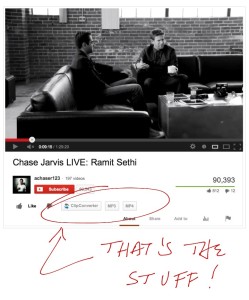
The latter, who is by far the most beneficial, has also never been much simpler as long as you have the right tool: Clip Converter.

clipconverter3

A Shortlist To Get Started

After that, it’s a matter of curating what you’d like to listen to. I started a short list below. (I wanted to wait until I curated a monster list, separated by categories, but realized something was better than nothing, and a shortlist was more accessible than a monster one I envisioned):

Another thought on the benefits of audio: I recently completed a Career Mastery pilot program created by Scott H. Young and Cal Newport. It was a four-week email course, where they explained the principles in writing and you completed “homework” that was emailed back to them. At the end of the pilot program, Scott and Cal conducted a “graduation webinar.” I struggled with the material for four weeks, and it wasn’t until the webinar that the concepts and theory really struck home. Hearing multiple examples of ideas in practice untangled the concepts for me, and for the first time since I joined the course, I had a clear idea of what I could accomplish with the strategies and how to go about it.

Choosing Who Surrounds You

There was a time when we couldn’t chose who surrounded us, or what ideas we immersed ourselves in, other than through books. But even that was limited, by access to the right books. Essentially we were locked to our context and our environment. Today we can pretty much immerse ourselves in anyone’s thoughts, and open ourselves up to whole new planes of thinking, without so much as leaving our computers. With unlimited access, it’s never been so easy to change our lives, and any excuse not to, falls on ears filled with the voices of people who already have.

Photos Credit: Jacob Bøtter

For the last few months, my creative output has been in a rut. I didn’t understand how or why. I don’t attribute it to “writer’s block.” (The idea of “writer’s block is stupid. Typing the words is cringe worthy.) The problem, I realized, was how I batched my work.

My Old Morning Routine

Wake at 6 a.m. By 6:30 a.m., I’d sit to write (having washed up and eaten first.) I’d squeeze in 60 minutes of work before getting ready for my bike commute to work. A quarter of that time I spent “ramping up” so actual production lasted 45 minutes. Work consisted of a blog project that’s been in the works (and can hopefully talk about soon) or a script.

The problem was I didn’t protect and cultivate how I spent that time. For example, blog posts were a linear process: research, write, edit, polish, search for images, format the post, check the display, and schedule, in that order.

This methodology was neat and simple. It was also wrong. It didn’t leverage that Golden Time in the morning: alone, with an unopened inbox. A time to be completely selfish. I should carve out this time specifically for activities that require complete focus: writing and editing for content. The rest: polish (line editing), searching for images, formatting, display and scheduling don’t require the same level of concentration. Why waste my most precious commodity (uninterrupted time) on these activities?

I changed the morning routine to leverage this commodity. I want the best opportunity to do good work, and batched the work differently to focus on the right things at the right time.

alarm clocks

My New Morning Routine (for now)

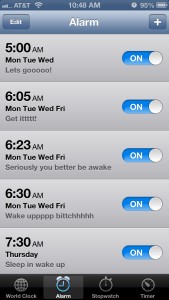
Monday through Wednesday: I wake at 5 a.m. I wash up, drink a protein shake and make coffee. I’m sitting and planning my day by 5:30 a.m. Basically, I ask myself: what do I want to accomplish with my day? What projects will I work on and in what order? If I could only accomplish one thing, what would it be? Sunday evenings I queue up a shortlist of work, so I already have a good idea of the projects and the order to approach them.

From 5:30 a.m. until 7:30 a.m., I only produce. I don’t research, I only edit for content, and I don’t post. It’s about creation only. In the morning stillness, as the sun rises outside the back patio, before the Los Angelinos climb into their steel boxes and head for the 10, I produce more in a single day than what I’d produce in an entire week, under the old schedule. Batching time and work gives me the opportunity to melt into the work, something the old routine didn’t provide. I don’t listen to music. I don’t open a browser. I don’t fend off non-stop interruptions, spending half the time rebuilding momentum or recapturing a train of thought. (This applies not only to writing, but at work, as well. Carving out time, when I’m not under siege by requests from any of the three bosses, or the phone isn’t ringing every 45 seconds, I can attack a Literary Option Agreement long enough to make my comments, or study a lawyer’s comments on a deal to acquire character rights to an Author’s best selling series.)

That is my Monday to Wednesday routine. Thursday I sleep in until 7:30 a.m. I don’t do any work on Thursday morning. It’s typically the only day I drive to work (depending on my drinks schedule) so I practically wake up, eat, and then I’m out the door. On Friday mornings, I wake at 6:30 a.m. and line editing or research before headed to work. This type of low-intensity work I spread throughout the day. Saturday mornings I switch back to high intensity, content producing work.

High Level Thoughts on a Morning Routine

  • Importance of “rest” days – my “rest” days are analogous to working out rest days. In order to produce, you need to recover. I recover on Thursdays and Sundays. Most days I go to sleep around midnight, so by Wednesday morning at 5 a.m., I am sluggish. The way I push through is knowing I have a rest day coming up.
  • Urgency – The first two minutes after waking up feel are the most difficult. It’s warm and comfortable and I have the love of my life asleep next to me. Drifting back to sleep is all I want and on the weekend I’ll occasionally indulge myself. But lately, I’ve been more aware of a sense of urgency. It comes from a combination of things, I think: being in my late 20s, surrounding myself with people who’ve pushed themselves to accomplish great things, being aware that now is the time to take risks and work on projects that I can point to and say, “this may not work” and still effortlessly bounce back from the consequences. This won’t be true forever. The urgency helps propel me out of bed in the morning.
  • “Next action” – I always mark exactly where I ended in a post or idea. It’s eloquently notated with (yes, in all caps) “MING YOU ARE HERE.” It’s difficult to miss. I also write in my project to-do list the next two steps in completing a task, so I always know the direction I’m moving in. This is as simple as, for a blog post, “look up images” and “format post.” At work, it’ll read, “study reversion clause” and “memorize book royalties and break points on the LG contract.”

I’ll adhere to this morning routine for the next six months. Circumstances change, however. For example, if I got a new job, or if I start a new project that involves filming on the weekends — the morning routine needs to flex with these changes. The important idea is: revisit your routines every few months, even if you “feel” like you’re accomplishing a great deal in its current iteration. Can you batch your time and work better? Are you leveraging your greatest resources, at the proper time?

Photo Credit: Nikola and Tamara

At LAX in the baggage line stood a family of six: Mom & Dad, the boy (7-years-old and the eldest,) two girls and a baby of unidentified gender. Behind them, the things they carried: Dora the Explorer roll-y bags, cheap carnival-won plush animals popping out of backpacks like Whack-a-Moles, Samsonite luggage and a car seat. The kids were quiet. Elephant-dart tranquil. When Mom asked them to stand aside, so they could get everything sorted, they obediently did so. With even the softest palette of primary colors, Norman Rockwell couldn’t paint domesticity this serene.

Yet the parents looked absolutely haggard. Pacquiao could warm up on the bags beneath Mom’s eyes. She wore a hand-knit scarf the color of Kansas’s skyline that accentuated the lines by her eyes. Dad raised a hand to push back his thinning black hair, and exposed the pouch of a Once-Upon-a-Time baseball player. He kept the weight at bay for years with after work jogs and heavy-weight/low-rep lifts, but now when he returns home he’s tripped up worse than an AT-AT Walker on Hot, by a toddler-barrage fighting for his attention.

I always (half-) jokingly said I’d like five children. I have three siblings already and thought there was room for yet another little person to look up to me and adore me, as I’m vehemently assured my brothers and sister always did. A family of seven would have been wonderful.

Watching the spectacle at LAX was the first time I examined the possibility of raising five children through the lens of a parent, however. The idea, now, requires revisiting.

Revisiting ideas through a different lens is why I track the books I read, and ideas as I read them, in Evernote and here. At different junctures of life and career, the lens changes — we change focal length by moving closer or further from the situation, we shift the curve of our trajectory, or there’s new clarity when something was once opaque. It’s an exercise in self-development and self-awareness, but more importantly, it exercises our ability to understand others. To empathize with others.

Isn’t that what self-development is? Seeing the world through someone else’s lens, and realizing that we are not always right, and they are not always wrong?

Photo Credit: Katja Kemnitz

I’ve upped biking to work to 3x’s a week – which has been freaking fantastic for clarity of mind, but made it tough to listen to self-development shiz at the same quantity as before. I did find time to slip in this short interview last week: it’s Marie Forleo* interviewing Ramit Sethi on her show, about selling. My notes below as usual. The main message is a good one, and both Ramit and Marie lay out great examples: niche down on “who is your customer?” like a motherf*cker. Ask “who are you targeting?” and “who aren’t you targeting?”


01:35 – “One of the things you’ll find is that we’re not specific enough, with who we’re going after and what your product does. For example, I have a course called Earn 1K on the side… It took us 6 months to get that name.”

02:24 – He breaks down why he chose the name “Earn 1K on the Side”:

Earn 1K – many successful students earned more than that, but he set a goal that people would find achievable.

On the Side – to combat the idea you’d need to start the next Google or quit their day jobs if they wanted to start their own business.

03:21 – “Alot of your students are using very similar phrases, and are in the relationship or financial area… and not many of them were as specific as they could have been. If you are trying to help your customers with their relationships, who are you targeting? When I asked this question, many people said, ‘women.’ That’s not specific! How old are they? They said, ’25 to 54′. Okay, there is virtually nothing identical to a 25-year-old woman to a 54-year-old woman. In fact, if you’re talking about love, they think of love totally different. What if they went to an Ivy League college? She thinks of love differently. You have to get really specific. For example, I’m targeting 24-to-29-year-old women who are interested in X,Y,Z and this is what they’re doing.”

04:27 – “The second question to ask is, ‘Who am I not targeting?’ That brings us to a whole other question, on why we don’t get specific.”

04:50 – MF “Not drilling down, not getting specific, from a business and marketing perspective, is shooting yourself in the foot.”

04:59 – “In a world of infinite choices, when you see something that is not directly for you, you close the window and move on. When you try to appeal to everyone, you appeal to no one.

06:38 – “Put yourself in the mind of your client. If they’re 24, what language do they use, what are they looking for, how much are they going to be willing to pay? When you can reach directly to what they want, you’ll find that not only will your clients be happier, but your business will dramatically grow because price will become a mere triviality. You’re actually solving a problem by getting specific.”

07:45 – “So they want to empower women to live the life of their dreams? Okay, let me tell you five ways… buy a nicer shirt, better haircut, nicer car, make more money, find the life partner they deserve… Okay? So are you selling cars or are you selling shirts? What exactly is it that you’re selling? Empowering is a good word, but it’s so general, without additional positioning it’s meaningless. What happens is, we’ll look at really large companies and say, wait a minute, Coca-Cola is selling happiness! Well they’ve been around for a 100 years and they have a multimillion dollar market cap. People know what Coca-Cola represents. When you’re starting out, no one knows who you are.”

09:07 – “One of the best things you can do when you’re getting specific is to show three or four testimonials of before and after. P90x does this really well. You see ultimate specificity.”

I remember listening to David Siteman-Garland interview Marie Forleo on The Rise to the Top. She was telling him that her production value used to awful, a far cry from the polish it has now. That’s how you get started though… put out what you can, slowly develop your skill sets, and build upon what you created yesterday.

Photo Credit: Jared Goralnick

Work has been giving me an emotional beat down with fists wrapped in quarters lately. Last month, I’ve nearly torn out my eyebrows over the bullshit monotony of scheduling, rescheduling, and emailing. It’s an assistant’s mental equivalent of “I-pick-stuff-up-I-put-stuff-down.” At the end of a day, I’ve spent 90 percent of my time pushing around paper, minus the paper.

This isn’t a rant against who I work for, my role, or my industry. I understand this shit has to get done, and why I’m the one shoveling it. My “win-days” have become those when I manage to carve out 30 minutes of my own to do Deep Study of Literary Option Agreements. For example, last week I sat down and studied Force Majeure and Claim Extension language until I understood it.

force majuere language

Typically my eyes rolled into the back of my head every time I reached any Force Majeure language. Now I understand that while a claim can be capped at 12 months (meaning someone has 12 months to sue or get off the pot) once a claim enters litigation an Option is suspended until it’s settled or litigated — there is no cap.

Everyday, people must engage in an emotional joust against the minutiae. Is there any question to why people stop caring about creating extraordinary work? Apathy is the result of getting ground down by the bullshit tasks we endure, and there are two ways it’s going to go:

You either let it stomp you flat.

Or you grind back.

Surrounding myself with self-development helps with the latter.

purple cow

I finished PURPLE COW by Seth Godin. A remarkable book about being remarkable, covering facets from nearly every industry (though, now that I think about it, I’m not sure if entertainment was covered). Nonetheless, it’s something to inoculate us in our quest to develop into who we want to be and achieve our own goals.

As always, below are noteworthy sections from the book. Bolding is mine.

Remarkable marketing is the art of building things worth noticing right into your product or service. Not slapping on marketing as a last-minute add-on, but understand that if your offering itself isn’t remarkable, it’s invisible.

The new rule is: Create remarkable products that the right people seek out.

The marketer of yesterday valued the volume of people she could reach. Mass marketing traditionally targets the early and late majority because this is the largest group. But in many markets, the value of a group isn’t related to its size — a group’s value is related to its influence. In this market, for example, the early adopters heavily influence the rest of the curve, so persuading them is worth far more than wasting ad dollars trying to persuade anyone else.

I don’t think there’s a shortage of remarkable ideas. I think your business has plenty of great opportunities to do great things. Nope, what’s missing isn’t the ideas. It’s the will to execute them. My goal in PURPLE COW is to make it clear that it’s safer to be risky – to fortify your desire to do truly amazing things… One of the best excuses your colleagues will come up with, though, is that they don’t have the ability to find the great idea, or if they do, they don’t know how to distinguish the great idea from the lousy ones.

If a product’s future is unlikely to be remarkable — if you can’t imagine a future in which people are once again fascinated by your product – it’s time to realize that the game has changed. Instead of investing in a dying product, take profits and reinvest them in building something new.

It’s not an accident that some products catch on and some don’t. When an idea virus occurs, it’s often because all the viral pieces work together. How smooth and easy is it to spread your idea? How often will people sneeze it to their friends? How tightly knit is the group you’re targeting – do they talk much? Do they believe each other? How reputable are the people most likely to promote your idea?

Cheating

  • Jetblue – low-cost structure and underused airports give them unfair adv
  • Starbucks
  • Vanguard – low-cost index funds makes it impossible for a full-service broker to compete
  • Ducati – they don’t make motorcycles for the entire market, they can specialize in high-profit, amazing bikes, which sell out every year
  • To their entrenched but nervous competitors, these companies appear to be cheating because they’re not playing by the rules. Why aren’t you cheating?

It’s easy to look at the idea diffusion curve and decide that the juicy, profitable, wonderful place to be is right in the center, where all the people are. However, that’s rarely true. Often, the valuable slices are located to one side or the other. What this bank might realize is that b focusing on these innovative customers, the bank may be able to bring in even more highly profitable risk-seeking customers, leaving the slow and declining sector to seek other (less profitable) banks. Differentiate your customers. Find the group that’s most profitable or most likely to sneeze. Figure out how to develop/advertise/reward either group. Ignore the rest.

We’ve been raised with a false belief: We mistakenly believe that criticism leads to failure. From the time we get to school, we’re taught that being noticed is almost always bad. It gets us sent to the principal’s office, not to Harvard. Nobody says, “Yeah, I’d like to set myself up for some serious criticism!” And yet… the only way to be remarkable is to do just that. You do not equal the project. Criticism of the project is not criticism of you. The fact that we needed to be reminded of this points to how unprepared we are for the era of the Cow. Will you do some things wrong in your career and be justly criticized for being unprepared, sloppy, or thoughtless? Sure you will. But these errors have nothing at all to do with the ups and downs you’ll experience as a result of being associated with the Purple Cow.

Lionel Poilane: French bread baker who did extensive research, interviewed more than 8,000 French bakes about their techniques. His sourdough bread is are with just loud, water, starter, and sea salt, and it’s baked in a wood-fired oven. At first, the French establishment rejected his products, considering them too daring and different. But the overwhelming quality of the loaves and Poilane’s desire to do it right finally won them over. Last year, Lionel sold more than $10 million worth of bread.

A the same time, the marketplace is getting faster and more fluid. Yes, we’re too busy to pay attention, but a portion of the population is more restless than ever. Some people are happy to switch their long distance service, their airline, their accounting from — whatever it takes to get an edge. So while fewer people attempt to become the Cow, the rewards for being remarkable continue to increase! At work is the ability of a smaller portion of eager experimenters to influence the rest us. It’s too easy to sit out the next round, rationalizing that you’re spending the time and energy to build on what you’ve got instead of investing in the future.

The opposite of “remarkable” is very good. Very good is an everyday occurrence hardly worth mentioning.

The Magic Cycle of the Cow – it’s the sneezers we care about:  

  1. Get permission from people you impressed the first time to alert them the next time you might have another cow. Not permission to spam them or sell them leftovers or squeeze extra margins from them.
  2. Work with the sneezers in that audience to make it easier for them to help your idea cross the chasm. Give them the tools (and the story) they’ll need to sell your idea to a winder audience.
  3. Once you’re crossed the line from remarkable to profitable business, let a different team milk it. Productize your services, servicize your products, let a thousand variations bloom. But don’t believe your own press releases. This is the inevitable downward slide to commodity. Milk it for all it’s worth, and fast.
  4. Reinvest. Do it again. With a vengeance. Launch another Purple Cow to the same audience. Fail and fail and fail again. Assume that what was remarkable a last time won’t be remarkable this time.

Where does remarkable come from? Often, it comes from passionate people who are making something for themselves. The Burton snowboard, the Vanguard mutual fund, the Apple iPod, and the Learjet, Starbucks coffee, people working at Patagonia.

Robyn waters is the person who persuaded Michael Graves to make a teapot for Target. She’s the one who searches out amazing cheap (but cool) flatware, and little pens with float in targets in them. Instead of spending time and money trying to buy market share with a advertising, Target has realized that b offering exclusive items that would be cool a any price — but that are amazing when they’re cheap – they can win without a big ad budget. If a big-box retailer like Target can obliterate Sears and Kmart, what’s stopping you from being many degrees cooler than your bigger competitors? 

Photos Credit: Dallas Moore